Ho scritto alla mia Jazz band preferita di Torino dopo 10 anni di “Non Commerciale”

Tutto il pianeta sta adottando AI generative a caso, cagando sull’ambiente con intensità esponenziale, in cerca di allucinazioni sempre migliori. Grazie a questo, le allucinazioni organiche di noi umane sono sempre più accettate.

Quindi, caro parrucchiere, ho trovato uno sport estremo da tastiera: dare il mio indirizzo di casa ad una intera jazz band, invitandoli a picchiarmi nel caso non fossero d’accordo con la mia proposta sul cambio di licenza di copyright 👍

È andata così:

Ciao XXXX :)

Non ci crederete ma questa è una lettera che ho abbozzato 10 anni fa. Quindi mi permetto di parlarvi come davanti ad una birra ghiacciata fra amici. Anche perché FA CALDO!

Sono Valerio. Sono uno scarso jazzista sax ma decente programmatore Open Source, volontario in diverse associazioni di volontariato nell’ambito dell’Open Source e dei contenuti liberi, sono presidente dell’associazione nazionale non-profit Italian Linux Society, sono volontario di Wikipedia, e altre cose totalmente a c**** di cane (tengo
in effetti online i server di Border Radio da diversi anni ormai, ecc). Questa è una email personale fra me e voi.

Vi ho incontrati 10+ anni fa durante il lancio del vostro progetto Creative Commons a Torino con Border Radio e ho pensato:

“c****! finalmente Torino produce musica f**a e senza ‘tutti i diritti riservati’! Questi sono dei fighi! Diamogli tutti i miei soldi”

All’epoca avevo pensato che un giorno sareste stati interessati a valutare una licenza ancora più open, compatibile con Wikipedia, Wikimedia Commons, videogiochi Open Source ecc. Per cui, sicuramente non vi ricorderete di me – ma abbiamo parlato circa 2 minuti proprio sul tema della licenza:

Sostanzialmente vi avevo chiesto come mai avevate proprio scelto la clausola “non commerciale”, e che crea appunto un monopolio commerciale, e se avevate valutato i benefici del passo successivo, cioè la stessa licenza di Wikipedia, che porta benefici totalmente differenti e inaspettati (viralità, “copyleft”), ecc.

All’epoca mi avevate risposto tipo che già alcune persone ve l’avevano chiesto, ma volevate cercare di non vivere sotto a un ponte per tutta la c**** di vita e quindi non trovavate molto senso nell’autorizzare altra gente a fare miliardi di soldi con la vostra musica :D o qualcosa del genere.

Avendo capito l’andazzo, vi ho preso 5 CD per sostenere l’iniziativa comunque estremamente innovativa (P.S. ero uno studente squattrinato, mai comprato musica né prima, né dopo) e vi ho salutati con “boh comunque ve lo richiedo fra 10 anni :D”

ED ECCOMI :D

Passo quindi alla domanda del c**** ficcanaso che finalmente ha senso fare dopo questi anni:

Con la vostra esperienza, posso chiedervi se siete onestamente molto contenti del totale dei soldi ricevuti dai soli *download* del vostro album XXXX degli ultimi 3 o 4 anni dalle piattaforme online?

Per quanto vi auguri un sacco di fortuna… temo mi confermerete che al massimo, dai download, ci pagate una pizza di gruppo all’anno birra esclusa. Piuttosto, immagino avrete MOLTE più collaborazioni e MOLTE più serate ecc. e quindi relativamente molti più introiti legati a nuove live performance, ecc.

Ipotizzando che vi faccia quindi piacere raggiungere nuovi risultati (cioè massimizzando visibilità, magari nuove serate, magari qualche articolo di grandi organizzazioni che parlano di voi, ecc) e ipotizzando vogliate il minimo sforzo per arrivare a ciò (cioè investire meno tempo possibile, meno soldi possibili, magari investire zero) per innescare questa nuova visibilità ecc.

Dunque, alla luce dell’attuale situazione in cui il vostro album è ancora sotto un monopolio commerciale (“Creative Commons NC”) e che questo negli ultimi 10 anni vi ha avvantaggiati solo fino ad un certo punto:

PROPOSTA INDECENTE :D

Sareste interessati a valutare l’avanzamento di licenza, da “CC BY-NC” a “CC BY-SA”, per almeno 1 singolo brano del vostro album, tipo – boh – XXXXXX?

Immaginate titoli sui giornali specializzati “Innovazione jazz a Torino: XXXX rilasciano brano come Wikipedia”

Dopo una cosa del genere, nelle migliore delle ipotesi: – uno YouTuber a caso in Norvegia usa il vostro brano come sottofondo e vi menziona (deve farlo) e gente a caso vi ascolta e magari vi dona qualcosa (notare che gli YouTuber di solito evitano musica “NC” – essendo incompatibile con le pubblicità native di YouTube).

– oppure, il vostro brano magari finalmente finisce su Wikipedia e Wikimedia Commons, piattaforme che hanno 50 miliardi di visite al mese (e che non accettano contenuti “NC”)

– oppure, un tizio del Pakistan a caso rivende il vostro brano in un negozio di vinili arrugginiti, in cui ci deve essere scritto il vostro nome (deve farlo) e la licenza (deve farlo) rendendovi ancora più famosi in villaggi pieni di mucche pelose, e magari portandovi fan e collaborazioni inaspettate a 8000 metri

– Wikimedia Italia magari pubblica un articolo sul suo blog su questa vostra iniziativa (come fanno spesso) (cosa che non farebbero mai con licenza non libera “NC”)

– qualche produttore di videogiochi Open Source mette il vostro brano come sfondo, mettendovi quindi nei crediti che appaiono a video, cosa che porta altri videogiochi a loro volta a fare la stessa cosa, ecc (i videogiochi Open Source non possono usare materiale “NC” altrimenti non sono inseribili su CD e non puoi vendere il CD nemmeno a 1€ ecc.)

– magari vi pagano per concerti eventi inaspettati in eventi tecnici Open Source, tipo al Linux Day Torino (è ogni ottobre, quest’anno 26 ottobre)

– che ne so, altre collaborazioni inaspettate

Nella peggiore delle ipotesi? Boh. Continuate a non fare soldi dai download?

(Ah, viviamo in momenti storici interessanti e la gente oggigiorno vuole proteggersi dalla “AI” ma questo NON è possibile: Se volete proteggervi dalla AI, sono spiacente di informarvi che era necessario 10 anni fa non produrre nulla e non mettere nulla né su Internet e né su CD e proibire a tutti di registrare. È troppo tardi. Seriamente. La AI se ne f**** di qualsiasi licenza e del copyright :D)

Comunque, nella peggiore delle ipotesi, mi venite a prendere a casa a darmi calci nelle palle – volentieri, ora abito a Milano, via XXX, XXX, citofono “Bozzolan”.

Possiamo fissare un incontro online di 10 minuti in cui parliamo di vantaggi e svantaggi di un eventuale cambio di licenza? :D

Un caro saluto ciao!

-Valerio (tizio a caso di Internet)

Non vedo l’ora di sapere quando e come la band risponderà a questa email 😻

Se non pubblicherò più altri messaggi significa che non è andata benissimo.
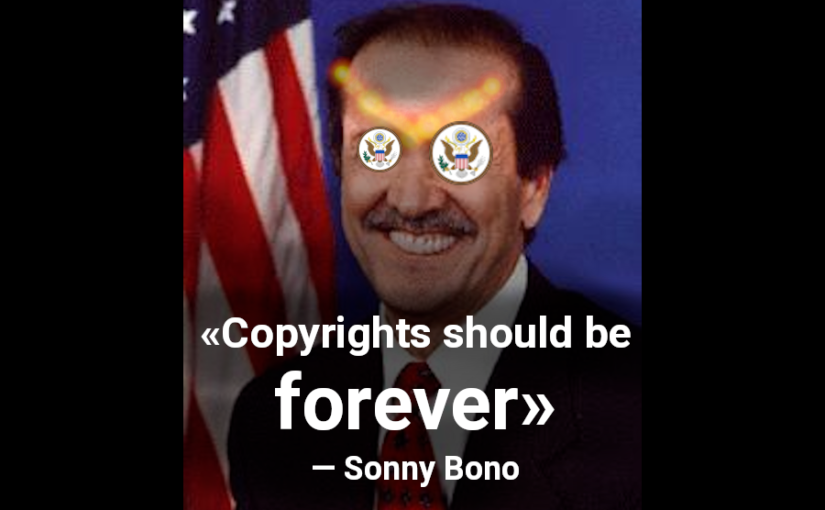
«Copyrights should be forever»

Welcome in copyrights should be forever: your friendly handbook guide for pure evil authors.

Spoiler: copyrights do not last forever. But with this guide you can make them last a very looooong time. Muaauahahah!

Let’s start!

Rule n. 1: You have copyrights

It happened! Do you remember when? You incised a new artwork on your school desk; you whistled a new astonishing tune in the shower; you wrote that beautiful poem about your ex partner; you draw a rat with round ears; etc.

Whatever is the way, you joined the community of authors and this means you gained a new power: copyrights (©).

Note: this guide is designed to empower your pure evil copyrights and raise your new Disney monopoly. This guide will not accept any refunds for people who will use this power to help others instead, for example adopting Creative Commons licenses.

Warning: It’s OK to dream your copyright monopoly but if you get the urge to extend copyrights for 400 years to protect a business over a damn hand-drawn rat, please consult a good doctor.

Facts about copyrights:

  • copyrights give you a monopoly by default
    • even without writing “all rights reserved” in bold
    • even without typing fancy characters like “©”
  • copyrights last for years
  • when they expire: public domain!
    • It means end of your monopoly

This means that if you create something original, you have a monopoly by default. You can be the only one on your planet able to copy it, and the only one able to decide who should use it and when.

Note that while this is the world of the Internet, and it costs little to no money to copy paste and send a song to billions of people, you have incredibly powerful rights that can stop this spread very effectively.

Anyway, death is for everyone, and it will touch your copyrights too.

Rule n. 2: Copyright has a deadline

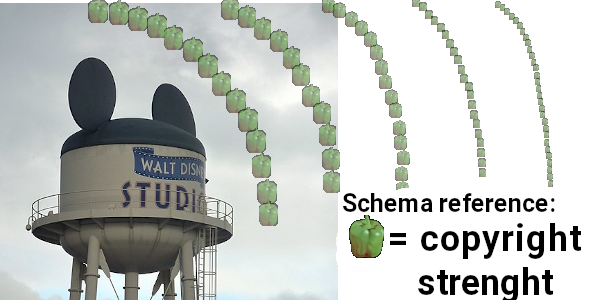
You can try to build antennas to amplify your copyright signal.

Walt Disney Studios tower copyright strenth technical reference
A rat tower trying to extend its copyright signal

Anyway, even with powerful antennas, your copyright power does not last forever and after some years your work enters the public domain.

Under public domain, the game is over, my friend: your evil empire has vanished. Your work doesn’t belong to a master anymore, and anyone can make whatever other creative stuff with it (movies, T-shirts etc.) without any written authorization.

Important: in short, to keep your monopoly, you have to fight public domain or convert public domain into something that is not public domain.

So the first thing you should do, is: try to extend your evil copyright powers as long as possible. Yaah!

One of the evil things you can do to kill public domain and enlarge your empire, is transforming public domain, for example, doing “creative digitalization” (HAHA!) taking “original photos” (HAHA!) of something in public domain, or stuff like that. Trust me: people will become mad for this.

But you also need some friends to kill public domain.
Note this name: Sonny Bono and his wife.

Uh? Who? Sonny Bono was a nice songwriter and a great politician. As songwriter Sonny Bono wrote… uhm… surely something (OK now I don’t remember anything in particular). As politician, instead, he supported this great piece of paper we will remember forever:

The “Sonny Bono” Copyright Term Extension Act

In short, Sonny Bono tried to extend his copyrights and everyone-in-the-world’s copyrights with this law. I don’t know if this can be considered a conflict of interest but the important fact is that he reached this goal successfully in 1998! Good for our evil empire.

Extends the duration of copyright in a work created on or after January 1, 1978, to the life of the author and 70 (currently, 50) years after the author’s death. Makes the same extension with regard to joint works created on or after such date.

https://www.congress.gov/bill/105th-congress/senate-bill/505
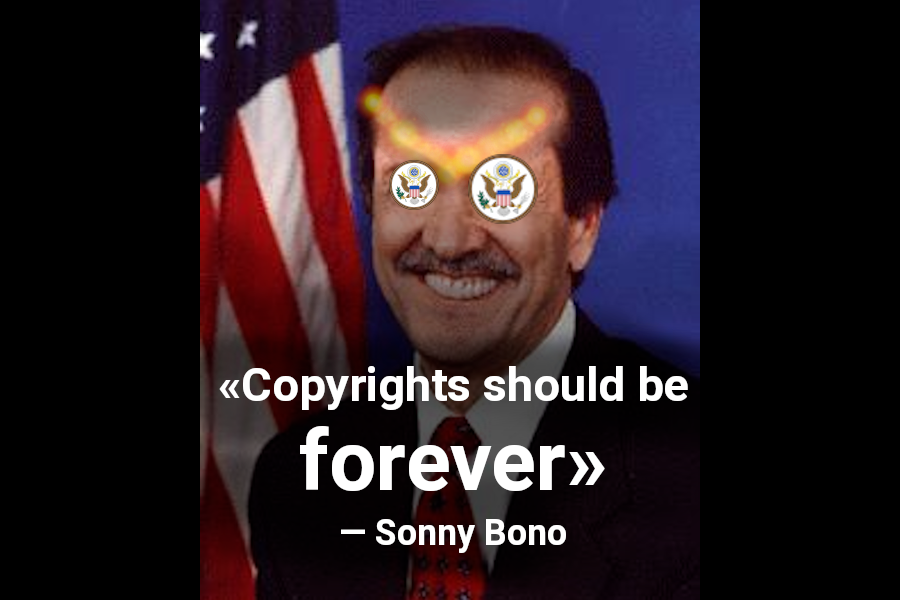
Sonny Bono copyright meme
This was the Sonny Bono Copyright Term Extension Act, or CTEA, enacted in memory of the congressman and former musician. According to his widow, Mary Bono, Sonny Bono believed that “copyrights should be forever.”
https://www.legalaffairs.org/issues/March-April-2004/story_lessig_marapr04.msp

This resulted in the historic lawsuits Eldred vs Ashcroft where some cute authors who had some cute business on public domain materials complained about a law that largely limited their room for maneuver, judging this law unconstitutional.

The lawyer “against Sonny Bono” was Lawrence Lessig. But I guess you already know this name. Lessig tried to fight with all his energy but, without our team of evil super-lawyers, Lessig lost.
Again, it’s a good news for your evil empire.

Rule n. 3: stronger copyright, stronger Creative Commons

Now you understand why in 2001 Lawrence Lessig helped in founding Creative Commons. Using copyright like a jujutsu, using the power of your enemy against it.

The core idea was similar to the one of the licenses written by Richard Stallman to protect Free Software: the copyright holder uses Creative Common licenses to give people more permissions over creative digital works, instead of denying all of them.

Note that, at the time, there was only the GNU Free Documentation License as an “attractive jujutsu license” for authors for creative contents. In short, the GNU FDL was just adopted for source code documentation and not for much more creative things (even if even Wikipedia adopted it for some time – so it wasn’t really such a lame license). That’s the moment when Creative Commons licenses were written and highly appreciated by creative authors.

When Creative Commons was founded in 2001, the internet was a budding universe with high potential, and platforms widely used today like Wikipedia and Google were only just getting started. CC’s founders were keen to hit the ground running, building on their work to ensure that, as the internet continued to grow, safeguards to knowledge, culture, and creativity were firmly in place.

https://creativecommons.org/2021/05/24/were-turning-20-whats-happened-since-2001/
by Creative Commons · CC BY 4.0

But in short. What is Creative Commons?

  • Creative Commons is a nonprofit organization
    • they provide Creative Commons licenses and tools
    • they support events and work with other organizations
    • they offer certifications and other tools
    • they work to help creative authors to share their work without relying on «all rights reserved» but «some rights reserved» instead
  • Creative Commons is a set of licenses
    • for example the “free cultural work” licenses:
      • CC BY
      • CC BY-SA
      • CC 0 (special license – public domain)
    • these license are adopted by Wikipedia, StackOverflow and lot of other platforms where collaboration should be encouraged and legally sustained
  • Creative Commons is a movement very active also on the copyleft front, fighting the restrictive “default” copyright culture of «all rights reserved», providing valid alternatives. This movement is a network of global and local movements, from Europe, Japan and South Korea and much more, causing CC license proliferation.

Rule n. 4: Creative Commons are everywhere

Pay attention, monopoly builder: Creative Commons works are under every corner!

Do you know what? YouTube, that platform with billions of visits, allows creators to upload videos under CC BY license:

https://support.google.com/youtube/answer/2797468?hl=en

Flickr is even more designed for Creative Commons authors with powerful filters to fit your needs:

https://www.flickr.com/creativecommons/

About nerd stuff, StackOverflow receives 100 MILLIONS developers each month on their website, serving contents under CC BY-SA:

https://stackoverflow.com

https://stackoverflow.com/help/licensing

Wikidata ha 95+ MILLIONS pages in public domain, thanks to CC 0:

https://www.wikidata.org/wiki/Wikidata:Main_Page

Wikipedia has millions of pages under CC BY-SA served to 45 BILLIONS visitors each month:

https://stats.wikimedia.org/

Lot of people joined communities to work together to kill your evil empire of «all rights reserved». For example, the CC Global Network is a community of members committed to spread Creative Commons in the world.

To join, you must choose two existing Individual Members to vouch for you:

https://network.creativecommons.org/

Rule n. 5: GLAMs, GLAMs everywhere

The Open GLAM project seeks to invite museums, cultural institutions, archives, libraries, and many others on how to better achieve their preservation and dissemination goals through digitization and Creative Commons licensing, especially thanks to archival projects like Wikimedia Commons.

Wikidata is another very interesting platform that is changing the world, allowing to store and search almost whatever metadata about any artwork in the world, and other things that proprietary archives often does not allow in such scale. That is very loved by GLAMs.

To do that, GLAMs have a real framework of licenses and case studies and other tools to amplify their impact on human beings, without relying on «all rights reserved».

See this simple GLAM launchpad:

https://outreach.wikimedia.org/wiki/GLAM

In short. If you want to make a monopoly, you don’t have to do anything, you’re already doing it. If instead you want to contribute to global knowledge, join Creative Commons and promote public domain (CC 0), CC BY, or copyleft (CC BY-SA) to spread “free as in freedom cultural works“. Or, at least, try other compromises such as the non-commercial or non-derivative versions.

Thank you for reading!

Note

This post is the result of the Creative Commons certification assignment.

I mean, I was not paid to write this post. I’m just doing my homework!

Credits

You can do whatever you want with the texts and the images in this page, as long as you give the rights credits and as long as you don’t put “all rights reserved” on this stuff.

I’ve created these images with the Free Software GIMP, the GNU Image Manipulation Program.

Thank you for sharing! and copy-pasting! and editing! You can!